
Category: Uncategorized
-

Meta to Use Off-Site Business Data for Feed and AI Personalization [email protected] (The Hacker News)
Meta on Tuesday announced that it will use information shared by other businesses to personalize users’ feed and responses from its artificial intelligence (AI) chatbot, expanding its scope beyond targeted ads. “Businesses often share information about people’s activity on their sites with us to make ads more relevant,” Meta said in a statement. “We already…
-

Veeam Backup & Replication RCE Flaw Lets Domain Users Run Remote Code [email protected] (The Hacker News)
Veeam has released security patches to address a critical flaw in its Backup & Replication software that could result in remote code execution. Tracked as CVE-2026-44963, the vulnerability carries a CVSS score of 9.4 out of a maximum of 10.0. “A vulnerability allowing remote code execution (RCE) on the Backup Server by an authenticated domain…
-

Microsoft Restores Some GitHub Repos, Keeps Others Offline as Miasma Probe Continues [email protected] (The Hacker News)
Microsoft on Monday confirmed that it temporarily removed some GitHub repositories in response to a recent security incident that led to 73 of its open-source projects being compromised to inject an information stealer into the code. “Our priority is to protect customers and the broader ecosystem,” a Microsoft spokesperson told The Hacker News via email.…
-

WinRAR Flaw Exploited by Russia-Aligned Groups to Deploy Stealers in Ukraine [email protected] (The Hacker News)
Two Russia-aligned cyber attack campaigns have continued to exploit a security flaw in WinRAR to target Ukrainian organisations, almost a year after patches for the vulnerability were released. The activity has been attributed by Trend Micro to Earth Dahu (aka Gamaredon) and SHADOW-EARTH-066 (aka UAC-0226). It involves the exploitation of CVE-2025-8088, a path traversal flaw…
-
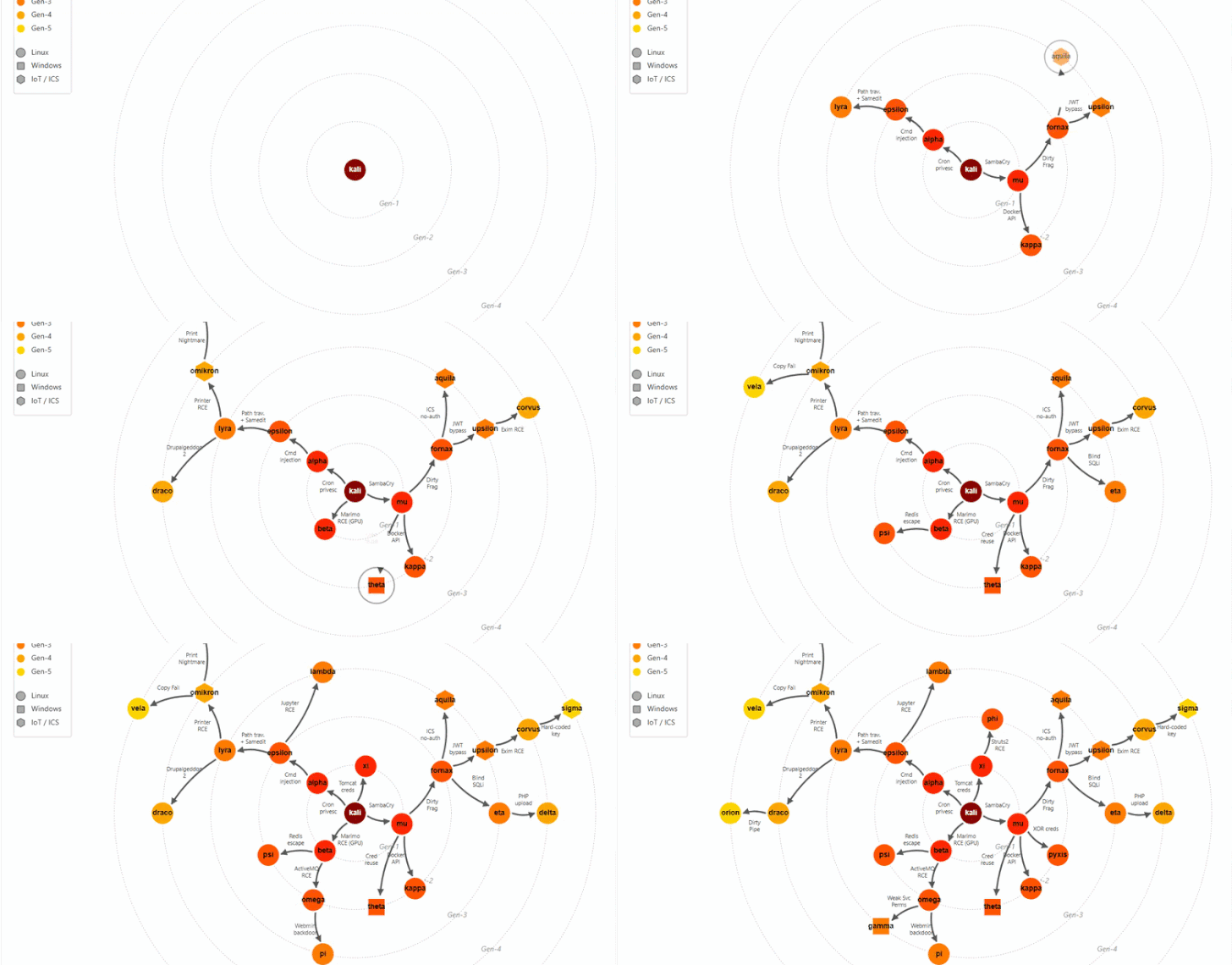
Researchers Build Self-Replicating AI Worm That Operates Entirely on Local, Open-Weight Models [email protected] (The Hacker News)
University of Toronto researchers have built and tested a proof-of-concept AI-driven computer worm that uses a locally hosted open-weight large language model to reason its way through a network, generate tailored attack strategies for each target it encounters, and replicate itself, all without human intervention and without touching a commercial AI service. The preprint, posted…
-

Chrome V8 Zero-Day CVE-2026-11645 Exploited in the Wild – Patch Now [email protected] (The Hacker News)
Google has released security updates to address 74 vulnerabilities, including one that has come under active exploitation in the wild. The high-severity vulnerability, tracked as CVE-2026-11645 (CVSS score: 8.8), has been described as an out-of-bounds memory access in V8, Chrome’s JavaScript and WebAssembly engine. “Out-of-bounds read and write in V8 in Google Chrome prior to…
-

The Hidden Security Risk in Modern Networks: The Work Between Tools [email protected] (The Hacker News)
Organizations have more visibility than ever. Growing tech stacks provide greater coverage, and network security teams are increasingly adopting AI and automation to help with routine tasks and reduce manual effort. But the same challenges persist. Outages still last hours, causing significant financial losses, operational disruption, and reputational impact. Threat response and mean time toRead…
-
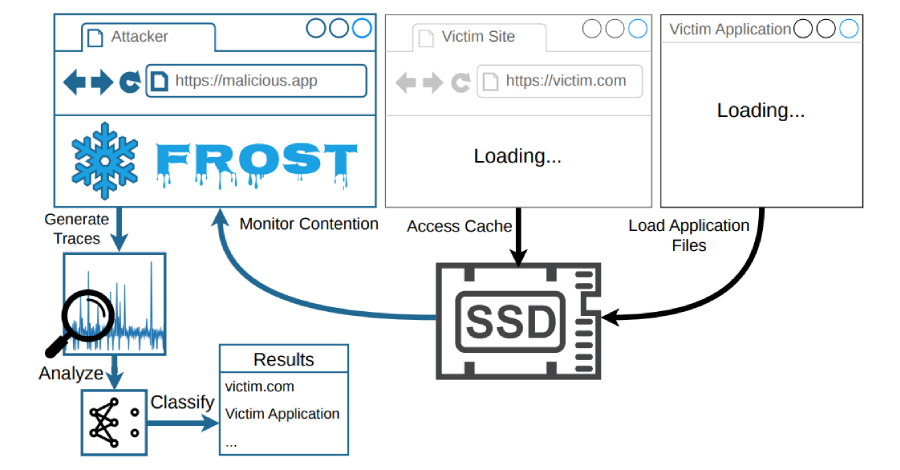
New FROST Attack Lets Websites Track What Sites and Apps You Open via SSD Timing [email protected] (The Hacker News)
A malicious website can work out which sites you visit and which apps you open, using nothing but JavaScript and the timing of your SSD. The attack, called FROST, needs no native code, no extension, and no permission prompt. You open the page, leave the tab sitting there, and it watches the drive for contention…
-

Hades PyPI Attack: 19 Packages Poisoned to Auto-Run Bun Credential Stealer [email protected] (The Hacker News)
The Miasma supply chain campaign has sparked a fresh attack wave called Hades, this time involving 37 malicious wheel artifacts across 19 packages in the Python Package Index (PyPI) registry, as the Mini Shai-Hulud-style attacks continue to be refined and splintered to target specific ecosystems. “The compromised releases shipped a *-setup.pth file that attempts to…
-

LiteLLM Flaw CVE-2026-42271 Exploited in the Wild, Chains to Unauthenticated RCE [email protected] (The Hacker News)
The U.S. Cybersecurity and Infrastructure Security Agency (CISA) on Monday added a high-severity flaw impacting BerriAI LiteLLM to its Known Exploited Vulnerabilities (KEV) catalog, citing evidence of active exploitation. The vulnerability, tracked as CVE-2026-42271 (CVSS score: 8.7), is a command injection vulnerability that could allow any authenticated user to run arbitrary commands on theRead More