
Category: Uncategorized
-

You Didn’t Get Phished — You Onboarded the Attacker [email protected] (The Hacker News)
When Attackers Get Hired: Today’s New Identity Crisis What if the star engineer you just hired isn’t actually an employee, but an attacker in disguise? This isn’t phishing; it’s infiltration by onboarding. Meet “Jordan from Colorado,” who has a strong resume, convincing references, a clean background check, even a digital footprint that checks out. On…
-

Noisy Bear Targets Kazakhstan Energy Sector With BarrelFire Phishing Campaign [email protected] (The Hacker News)
A threat actor possibly of Russian origin has been attributed to a new set of attacks targeting the energy sector in Kazakhstan. The activity, codenamed Operation BarrelFire, is tied to a new threat group tracked by Seqrite Labs as Noisy Bear. The threat actor has been active since at least April 2025. “The campaign is…
-

Malicious npm Packages Impersonate Flashbots, Steal Ethereum Wallet Keys [email protected] (The Hacker News)
A new set of four malicious packages have been discovered in the npm package registry with capabilities to steal cryptocurrency wallet credentials from Ethereum developers. “The packages masquerade as legitimate cryptographic utilities and Flashbots MEV infrastructure while secretly exfiltrating private keys and mnemonic seeds to a Telegram bot controlled by the threat actor,” Socket researcherRead…
-
News brief: U.S. Cyber Trust Mark update and how to prepare
Check out the latest security news from the Informa TechTarget team.Read More
-
Is storage the weak link in your cyber-resilience strategy?
While challenges exist in applying cyber resilience to storage platforms, vendors are starting to make it easier for organizations to add that needed layer of protection.Read More
-

CISA Orders Immediate Patch of Critical Sitecore Vulnerability Under Active Exploitation [email protected] (The Hacker News)
Federal Civilian Executive Branch (FCEB) agencies are being advised to update their Sitecore instances by September 25, 2025, following the discovery of a security flaw that has come under active exploitation in the wild. The vulnerability, tracked as CVE-2025-53690, carries a CVSS score of 9.0 out of a maximum of 10.0, indicating critical severity. “Sitecore…
-

TAG-150 Develops CastleRAT in Python and C, Expanding CastleLoader Malware Operations [email protected] (The Hacker News)
The threat actor behind the malware-as-a-service (MaaS) framework and loader called CastleLoader has also developed a remote access trojan known as CastleRAT. “Available in both Python and C variants, CastleRAT’s core functionality consists of collecting system information, downloading and executing additional payloads, and executing commands via CMD and PowerShell,” Recorded Future Insikt GroupRead More
-

SAP S/4HANA Critical Vulnerability CVE-2025-42957 Exploited in the Wild [email protected] (The Hacker News)
A critical security vulnerability impacting SAP S/4HANA, an Enterprise Resource Planning (ERP) software, has come under active exploitation in the wild. The command injection vulnerability, tracked as CVE-2025-42957 (CVSS score: 9.9), was fixed by SAP as part of its monthly updates last month. “SAP S/4HANA allows an attacker with user privileges to exploit a vulnerability…
-

Automation Is Redefining Pentest Delivery [email protected] (The Hacker News)
Pentesting remains one of the most effective ways to identify real-world security weaknesses before adversaries do. But as the threat landscape has evolved, the way we deliver pentest results hasn’t kept pace. Most organizations still rely on traditional reporting methods—static PDFs, emailed documents, and spreadsheet-based tracking. The problem? These outdated workflows introduce delays,Read More
-
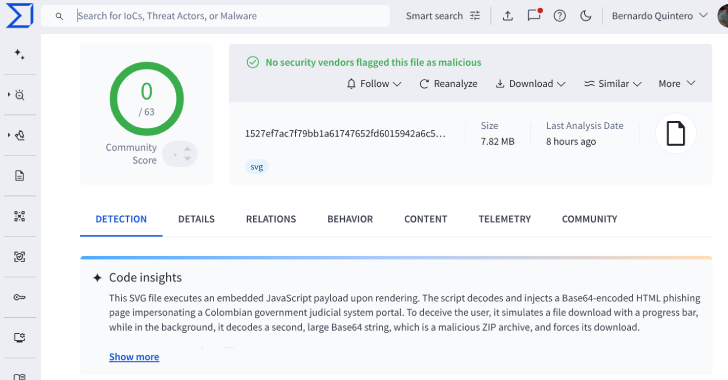
VirusTotal Finds 44 Undetected SVG Files Used to Deploy Base64-Encoded Phishing Pages [email protected] (The Hacker News)
Cybersecurity researchers have flagged a new malware campaign that has leveraged Scalable Vector Graphics (SVG) files as part of phishing attacks impersonating the Colombian judicial system. The SVG files, according to VirusTotal, are distributed via email and designed to execute an embedded JavaScript payload, which then decodes and injects a Base64-encoded HTML phishing page masquerading…